Tell us about the job
Takes about a minute. No obligation.
A contractor called out to repair a central AC unit in Maury County has to sort out what the system has actually been through before quoting a fix. 135 severe weather events were recorded in Maury County, Tennessee between 2015 and 2024. At that rate, severe weather is a routine condition for equipment here, and the condenser coils, capacitors, and contactor points that absorb the worst of it show up worn in ways that go beyond what age alone produces. A repair scope that does not account for that load risks replacing the wrong part first.
What a repair call turns up here depends less on the unit's nameplate and more on what is inside it once a contractor gets it open. Half the homes in Maury County, Tennessee were built in 1994 or earlier (2020-2024 ACS 5-year). Equipment running in stock that old has often been swapped out at least once, meaning the system a technician opens may be a mismatched assembly of components from different eras, some of which draw parts from supply chains that have narrowed or closed. That is the variable a quote has to account for before any other number gets written down.
The Parts of a Central AC a Contractor Checks During Repair
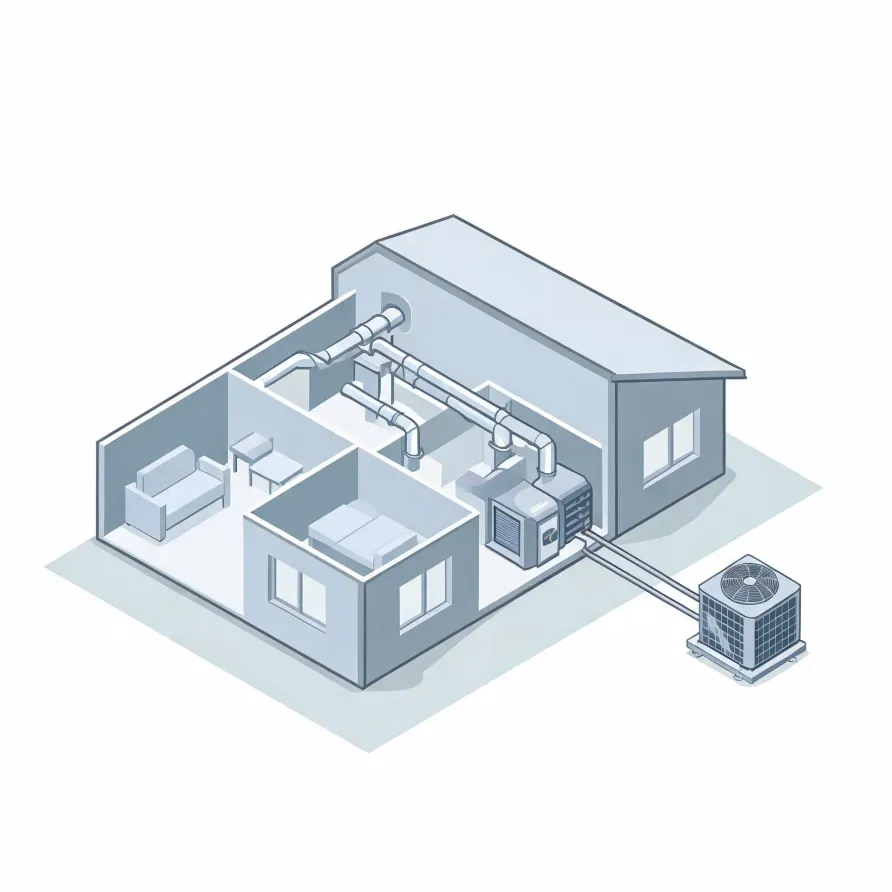
The outdoor condenser unit sits outside the house and holds the compressor, which is the component contractors look at first when a system stops cooling. The compressor drives the whole refrigeration cycle, so when it fails, nothing works. The condenser coil wraps around it and sheds heat to the outside air; a damaged or clogged coil is a frequent source of warm air inside.
Inside the house, the air handler contains the evaporator coil and the blower motor. The evaporator coil is where the cooling actually happens, and a refrigerant leak or a frozen coil usually shows up here. The blower motor pushes conditioned air into the supply side; when it runs weak or not at all, poor airflow is the result. The expansion valve and refrigerant lines connect the two units and are checked when pressures read off.
The drawing shows the general layout of a central AC system, and a licensed contractor determines which components apply to your specific house and situation.
Find a contractor in Maury CountyMaury County, by the numbers
135 severe weather events were recorded in Maury County, Tennessee between 2015 and 2024.
NOAA National Centers for Environmental Information, Storm Events Database, bulk CSV export, events 2015-01-01 through 2024-12-31.Half the homes in Maury County, Tennessee were built in 1994 or earlier (2020-2024 ACS 5-year).
U.S. Census Bureau, 2020-2024 American Community Survey 5-Year EstimatesMaury County, Tennessee holds 46,159 housing units (2020-2024 ACS 5-year).
U.S. Census Bureau, 2020-2024 American Community Survey 5-Year EstimatesOwners occupy 70.9% of the occupied homes in Maury County, Tennessee (2020-2024 ACS 5-year).
U.S. Census Bureau, 2020-2024 American Community Survey 5-Year EstimatesCodes & Standards Covering Central AC Repair in Maury County, Tennessee9 sourced rules and standards
What HVAC Repair Looks Like in Maury County
Split-system central air conditioners rated below 45,000 Btu/h manufactured on or after January 1, 2023 must meet a federal minimum of 13.4 SEER2.
Split-system central air conditioners rated at or above 45,000 Btu/h manufactured on or after January 1, 2023 must meet a federal minimum of 13.4 SEER2.
Split-system central air conditioners manufactured between January 1, 2015 and December 31, 2022 had to meet 13 SEER, the metric that preceded SEER2.
Single-package central air conditioners manufactured on or after January 1, 2023 must meet a federal minimum of 13.4 SEER2.
Space-constrained central air conditioners manufactured on or after January 1, 2023 must meet a federal minimum of 11.7 SEER2.
Federal efficiency standards for split-system central air conditioners and heat pumps are set on each certified combination of outdoor unit and indoor coil rather than on the outdoor unit alone.
Residential and light commercial air conditioning and heat pump systems assembled in the field, including mini-splits and unitary systems, may not be installed on or after January 1, 2025 using a refrigerant with a global warming potential above 700.
A field-assembled system whose specified components were all manufactured or imported before January 1, 2025 carries no installation compliance date under the refrigerant restrictions and may still be installed.
Licensing and Legal Requirements in Maury County, Tennessee
Tennessee licenses contractors by classification, and HVAC, refrigeration and gas piping is one of them — a sub-classification of mechanical contracting on the licence the Board for Licensing Contractors issues.
Severe Weather Events in Maury County
Weather puts hours on HVAC equipment. Every storm that moves through Maury County is a load event, and load events add up in compressors, capacitors, and contactors that were already working hard through a Tennessee summer.
135 severe weather events, 2015–2024. Source: NOAA National Centers for Environmental Information, Storm Events Database.